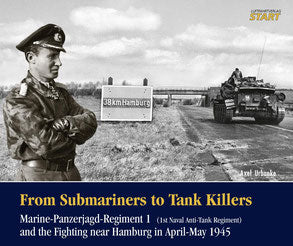
From Submariners to Tank Killers
At the beginning of April 1945, it became clear that the surrender of the Wehrmacht was only a matter of days or weeks. But despite this hopeless prospect, the German troops still put up fierce resistance to the enemy. Most of the front-line soldiers had long since given up hope of an already illusory final victory.
Other goals now had priority. The way to the west had to be kept open for columns of refugees; steps had to be taken to ensure that civilians and wounded comrades could be evacuated by sea; and a path to the west had to be cleared for their own troops. The great spectre on the Eastern Front was that of being overrun by the Russians and then being subjected to their reprisals.
Very few interested people today know that a stubborn fight against the British and Americans was also necessary on the Western Front in order to achieve these goals. So in April, the Germans were playing for time, because every day that the Wehrmacht troops in the West delayed surrender saved the lives of thousands, even tens of thousands of people in the East. But Hitler was still alive and making his unrealistic decisions in Berlin. To oppose his orders in those days could quickly mean death.
In this situation, Hamburg, a city of millions, made preparations for a „defence to the last round of ammunition“. Disaster loomed. Due to a lack of troops, at the beginning of April, the High Command of the Wehrmacht increasingly resorted to sailors whose ships had been sunk, were damaged, or are no longer able to sail due to a lack of fuel. Among these men were about 2,000 submariners who had been waiting in the Elbe metropolis for the completion or repair of their U-boats. Now, instead of putting to sea in their boats to fight the enemy, they stood up to the British with Panzerfaust anti-tank weapons as part of the 1st Naval Anti-Tank Regiment. Under the level-headed battle commander of Hamburg, they put up such a measured resistance that time was gained to finally surrender Hamburg without a fight and, by stopping the British at the Elbe, keep the Baltic ports open to refugees for about 14 days longer. This book is an exciting piece of contemporary history that provides a somewhat different view of the events of that time. Follow the submariners’ fight in the Harburg Hills and on the Elbe, which has never been summarised until today and which saved the lives of tens of thousands of people.
Important note for submarine enthusiasts:
Photos of Type XXI and Type XXIII submarines are known to be very rare. This book contains 31 unpublished colour photos of the construction of these boat types and their commissioning at Blohm & Voss and Deutsche Werft AG in Hamburg. The photos were taken as part of film recordings made by war correspondent Walter Frentz on behalf of Hitler. Frentz was to film all of the modern new weapons in the summer of 1944. During
filming, he privately made colour slides. The colour recording is therefore a small sensation that can finally be seen 78 years after it’s creation.
Original: $119.44
-65%$119.44
$41.80Product Information
Product Information
Shipping & Returns
Shipping & Returns
Description
At the beginning of April 1945, it became clear that the surrender of the Wehrmacht was only a matter of days or weeks. But despite this hopeless prospect, the German troops still put up fierce resistance to the enemy. Most of the front-line soldiers had long since given up hope of an already illusory final victory.
Other goals now had priority. The way to the west had to be kept open for columns of refugees; steps had to be taken to ensure that civilians and wounded comrades could be evacuated by sea; and a path to the west had to be cleared for their own troops. The great spectre on the Eastern Front was that of being overrun by the Russians and then being subjected to their reprisals.
Very few interested people today know that a stubborn fight against the British and Americans was also necessary on the Western Front in order to achieve these goals. So in April, the Germans were playing for time, because every day that the Wehrmacht troops in the West delayed surrender saved the lives of thousands, even tens of thousands of people in the East. But Hitler was still alive and making his unrealistic decisions in Berlin. To oppose his orders in those days could quickly mean death.
In this situation, Hamburg, a city of millions, made preparations for a „defence to the last round of ammunition“. Disaster loomed. Due to a lack of troops, at the beginning of April, the High Command of the Wehrmacht increasingly resorted to sailors whose ships had been sunk, were damaged, or are no longer able to sail due to a lack of fuel. Among these men were about 2,000 submariners who had been waiting in the Elbe metropolis for the completion or repair of their U-boats. Now, instead of putting to sea in their boats to fight the enemy, they stood up to the British with Panzerfaust anti-tank weapons as part of the 1st Naval Anti-Tank Regiment. Under the level-headed battle commander of Hamburg, they put up such a measured resistance that time was gained to finally surrender Hamburg without a fight and, by stopping the British at the Elbe, keep the Baltic ports open to refugees for about 14 days longer. This book is an exciting piece of contemporary history that provides a somewhat different view of the events of that time. Follow the submariners’ fight in the Harburg Hills and on the Elbe, which has never been summarised until today and which saved the lives of tens of thousands of people.
Important note for submarine enthusiasts:
Photos of Type XXI and Type XXIII submarines are known to be very rare. This book contains 31 unpublished colour photos of the construction of these boat types and their commissioning at Blohm & Voss and Deutsche Werft AG in Hamburg. The photos were taken as part of film recordings made by war correspondent Walter Frentz on behalf of Hitler. Frentz was to film all of the modern new weapons in the summer of 1944. During
filming, he privately made colour slides. The colour recording is therefore a small sensation that can finally be seen 78 years after it’s creation.